
Office furniture
Office furniture specification guide: tops, edges and E1 boards
Published 6 min read
Two desks can look identical and perform very differently five years on. The difference is in the board, the edge and the build, and none of it is visible in a showroom.
Here is what to put in a furniture specification, and what to ask a supplier to prove.
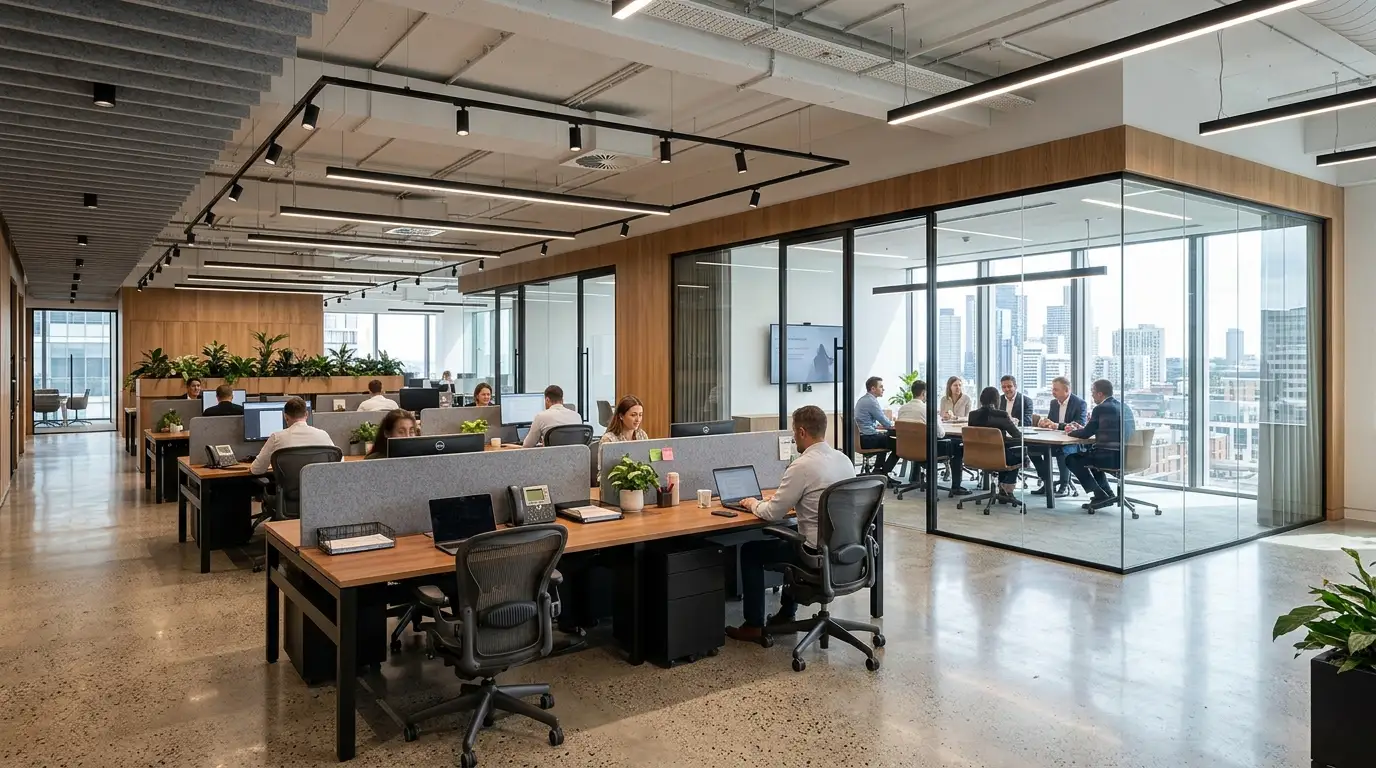
Typical specification
| Component | Typical spec | Why it matters |
|---|---|---|
| Desk top | 25 mm melamine-faced chipboard or MDF, 2 mm PVC edge | Resists wear, stains and moisture; the edge takes the knocks |
| Executive top | 30 – 40 mm veneered or laminated | Premium finish and room for hidden cable routing |
| Carcass (cabinets, pedestals) | 18 mm melamine board, E1 low-emission | Stable storage; E1 limits formaldehyde |
| Partition screens | 40 – 50 mm acoustic fabric panel on a steel or aluminium frame | Privacy and sound control in open plan |
Typical values for guidance. Final specification is confirmed per project.
The details that decide durability
Edge banding
A 2 mm PVC edge, properly glued, protects the board from knocks and moisture. Thin or peeling edges are the first failure.
Balanced construction
A backer on the underside of the top prevents warping.
Cable management
Cut-outs, grommets and trays planned in, not retrofitted.
Fixings and hardware
Metal fixings and quality runners and hinges last far longer than light-duty parts.
What E1 means
E1 is the low-formaldehyde emission class for wood-based panels. The reference test is a chamber method under EN 717-1, where E1 means a concentration below about 0.1 ppm (roughly 0.12 mg per cubic metre). Panels are usually declared to this class under the harmonised EN 13986 standard.
The label is only as good as the evidence. Results vary between products and test methods, so ask the panel supplier for the emission-class declaration or test report, not just a statement.
Dimensions and ergonomics
Desk dimensions for seated, sit-stand and standing work are covered by EN 527-1, which is based on the range of European office users from the 5th to the 95th percentile. It does not cover storage units or reception desks. Ask your supplier which dimensions they design to.
Frequently asked questions
Is a thicker desk top always better?
Not necessarily. A 25 mm melamine top with a good edge suits most desks. Thicker tops are used for executive pieces and where appearance or long spans demand it.
Can furniture be made to our drawings?
Yes. Dimensions, finishes and cable management are confirmed per project.
What warranty should we expect?
Ask for it in writing and check what it covers: board, edges, hardware and mechanisms.
More insights
Related
Let's build your next space.
Tell us about your project and we will reply within two working days.